One night in Bali, I emerged from a breathwork and soundbath event and was enveloped by warm, humid air. I blinked as I opened my phone to book a scooter home – this was before I learned to drive one myself – and waited patiently on the curb for the driver to arrive. After almost a year of traveling, I didn't often get rides home at night, because I wasn't usually out and about at this time. Once a night owl in New York, now I slept naturally with the cadence of the sun, the first rays of light replacing the artificial sounds of Apple's alarm.
He arrived, and I climbed on the back for the 15-minute ride home. As we gathered speed, I noticed dust getting in my eyes – usually during the day I had sunglasses – and without anything for protection, I closed them.
In an instant my world shifted as I experienced the exquisite heightening of all of my other senses, simply by removing one. Sound became prominent. The sound of the wind in my helmet that I had never noticed before. The feeling of the moving air brushing my cheeks. Everything in my body felt like it was moving faster. I was flying at a breakneck speed through space, the engines roaring like the ocean as the bikes ebbed and flowed in proximity to ours. Occasionally one would rev up and shock me like a firework.
I could not see, and so I had to trust. I had no clue when we would turn or end up on a bumpy street. Just hanging on for the ride, feeling each lean and brake as it pulled and pushed me. My stomach flipped in fear, even though I had done this ride many times before. I should have been able to anticipate the next moment, but I couldn't. Every ride before I had done with my eyes, while the rest of my body was now mapping it for the first time.
But my vision did not disappear; it changed. Because even with my eyes closed, the lights of the other bikes and cars penetrated my eyelids. Of all of the sensory input I received, it was the lights that delighted me the most. Yellow and red and white, like a disco ball they moved in rotation past my vision. It was art.
"Mindfulness is sensefulness." -Dr. Lorin Roche
There is a fantastic (albeit dense) book by Dr. Lisa Feldman Barrett called How Emotions Are Made that illustrates through her research on brain development why children are better at solving problems than adults.
The brain requires a disproportionate amount of energy to function when compared with the rest of the body: comprising roughly 2% of our body mass, yet using 20% of our energy, or about 300-400 calories per day.
Now that's what the brain uses on "eco-mode." The brain becomes efficient in energy use through prediction. It doesn't need to assess every situation or notice every detail if instead it can look for a pattern based on circumstances from the past, send those same signals to the body about how to act, and conserve energy for something that actually requires conscious decision-making.
See where I'm going with this?
 Clara Ritger
Related Read: In Namibia, I witnessed firsthand the ability of children to see what adults cannot.
Children, however, have no life experience on which to predict outcomes. Give them a problem to solve, and they're going to try every possibility they come up with, while adults only try the ones that "make sense." Their lack of discrimination means, according to Barrett's research, that they arrive at the solution faster than adults.
But it also means that when you're trying to get them ready for school in the morning, they're going to get distracted not because they're intentionally being difficult – okay, sometimes they are – but because their nervous systems are literally overloaded with sensory information. You're single-mindedly focused on the task – breakfast, brush teeth, get dressed, put on shoes, get out the door – while they're discovering that they don't like the texture of the cereal when it sits in the milk too long, getting used to the back and forth motion of their hand as they brush, and finding delight in the sound and feel of velcro as it connects and rips apart.
Getting ready for the day is exploratory and playful for children, but for you, it's a chore.
You're annoyed with them, but really, they should be annoyed with you.
You're living life on autopilot, and calling it "responsibility."
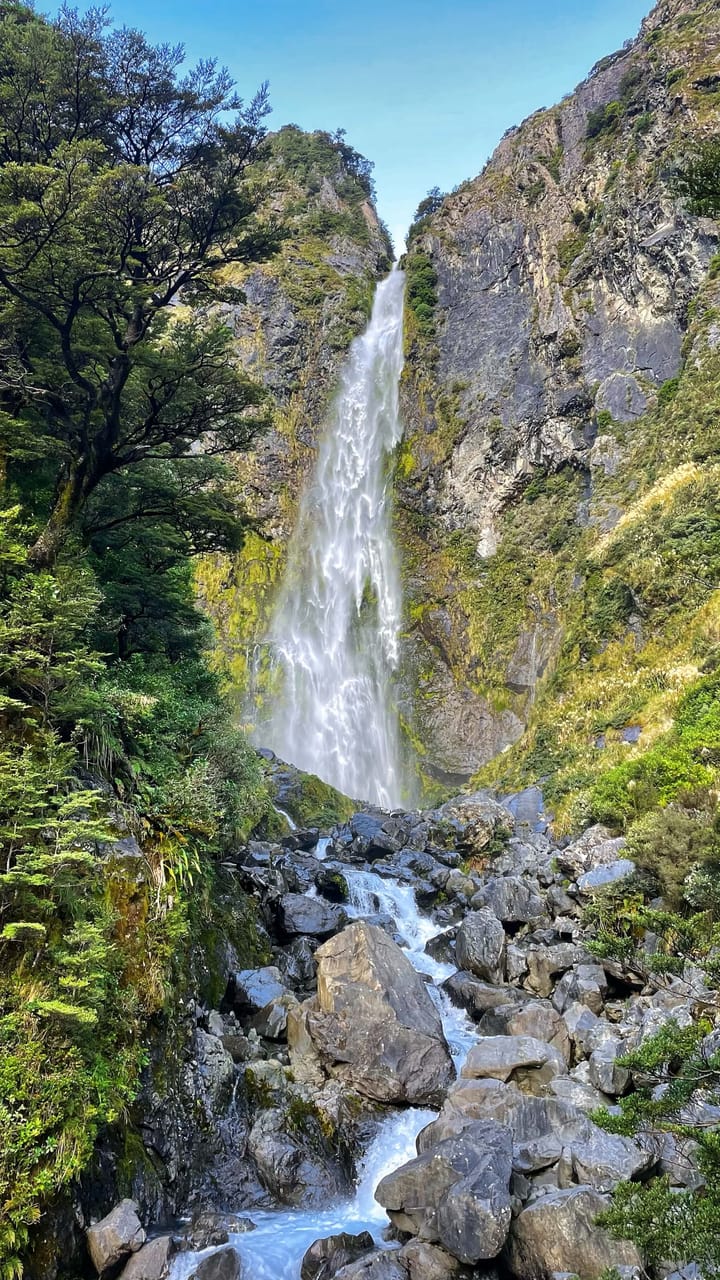
I spent so much time at this waterfall getting lost in the shapes the water made as gravity pulled it down from the cliff.
For many of us, travel forces us back into this way of being, because everything is new and unpredictable. We experience the heightening of our senses, as everything comes online to receive, perceive, and make "sense" of the world around us. We slow down and savor each moment. "Childlike wonder" is how we describe it.
And then we return home, back to our old patterns, and put away this feeling for the next time we go on vacation.
What does it look like to bring some of this sensefulness into our daily lives?
There's a balance, of course, that we must find in order to function in the modern world and at the unfortunate pace that it moves. Our brains are genuinely helping us to complete tasks without unnecessary effort when they choose dullness. The problem is, life starts to feel like a task when that's how our brains adapt to routine.
Here's five mindfulness – ahem, sensefulness – practices that I'm using to bring a sense of freshness and zest back into life: